

Our Methodology
The 8Ps Framework
The 8Ps Framework
Growing Enterprises That Create Good Profit and Enduring Impact
In an era marked by economic volatility, societal fragmentation, and declining trust in institutions, enterprises are being asked to do more than deliver financial results. They are increasingly expected to create genuine value for society, develop people meaningfully, and operate with integrity—without sacrificing performance.
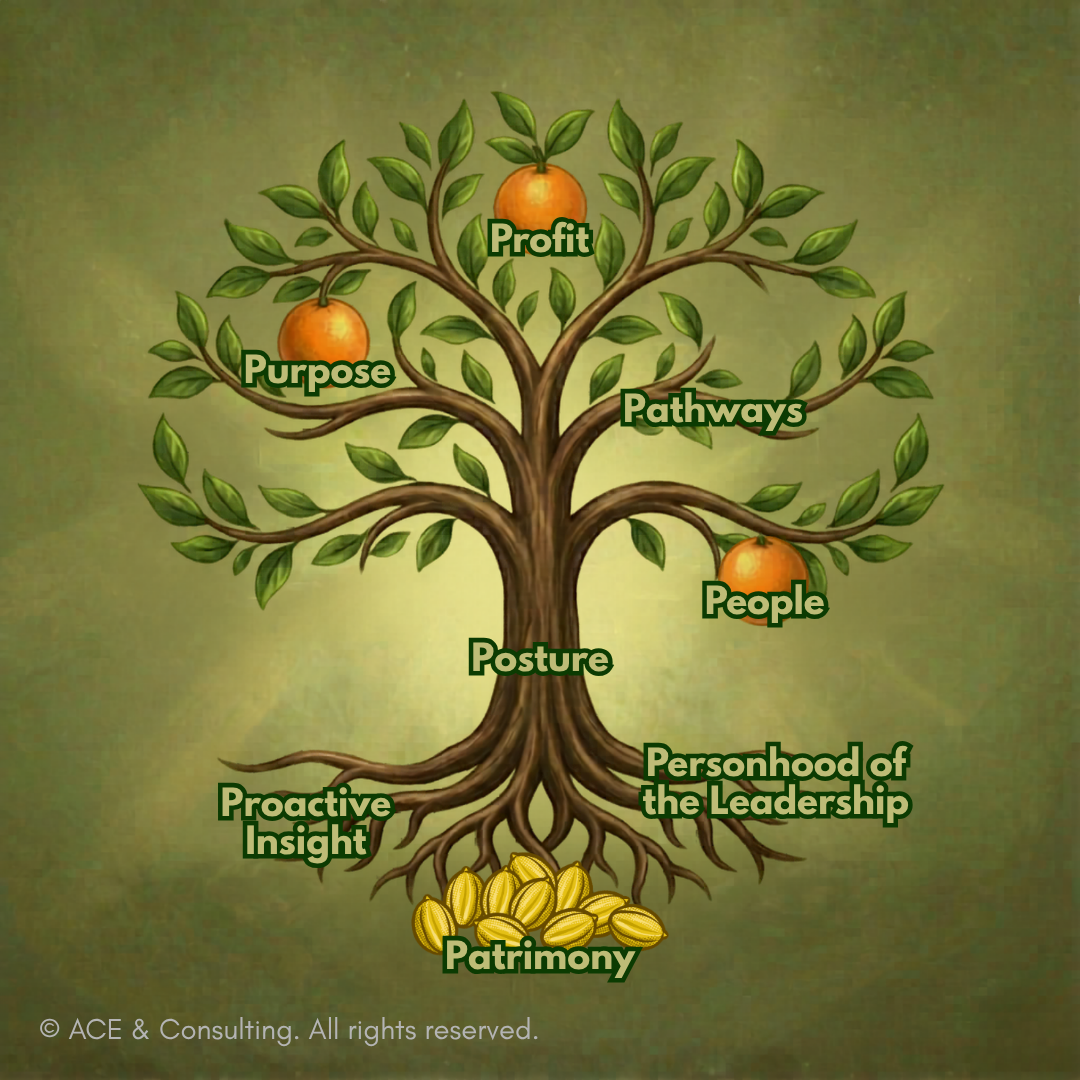
The 8Ps Framework offers an integrated way to understand how sustainable, high-performing enterprises actually grow. It views an organisation not as a machine to be optimised, but as a living system—much like a tree—where outcomes are shaped by deeper, often unseen drivers.
Deep Dive: The 8 Dimensions
Roots (WHY): Foundations That Determine Long-Term Value
Every healthy enterprise begins with strong roots. These roots define why the organisation exists and what ultimately sustains it through uncertainty and change.
Patrimony
Patrimony anchors the organisation in legacy, continuity, and stewardship. It reflects the accumulated values, institutional memory, and long-term impact that extend beyond immediate outcomes.
Rather than focusing solely on short-term performance, Patrimony ensures that decisions contribute to enduring value—preserving what matters while building for future generations.
It carries forward the organisation’s identity and wisdom over time, enabling growth without losing its essence.
Personhood of the Leader
At the deepest level, enterprises rise or fall on the character, maturity, and inner posture of leadership. Decisions are rarely neutral; they reflect values, assumptions, and moral boundaries formed long before strategies are discussed. Sustainable value creation requires leaders who see themselves as stewards, not merely operators or owners.
Proactive Insight
Healthy roots include the capacity for foresight, learning, and discernment. Leaders who cultivate reflective thinking and long-term perspective are better positioned to anticipate risks, identify emerging opportunities, and avoid reactive short-termism.
Trunk (HOW): The Integrating Core of Culture and Leadership
The trunk represents how purpose and values are carried into daily reality.
Posture (Attitude & Mentality)
Posture describes an organisation’s default stance toward reality—its humility before facts, openness to learning, willingness to confront problems, and commitment to responsibility. A healthy posture enables organisations to remain grounded during success and resilient during disruption.
Culture is not what is stated; it is what is repeatedly practiced. Posture determines whether values remain aspirational or become operational.
Branches (WHAT): Execution That Translates Intent into Action
Branches represent the visible structures and behaviours through which an organisation functions.
Pathways
Pathways are a combination of policies, practices, and problem solving that define how organisations move from intent to execution.
Clear policies and disciplined practices act as structured pathways that translate purpose into consistent action. They align incentives, clarify decision rights, and ensure that values scale as the organisation grows.
At the same time, mature enterprises do not avoid problems—they surface them early. Structured problem-solving and proactive risk management protect people, resources, and reputation, while driving continuous improvement and organisational learning.
Together, these form coherent pathways that guide decision-making, enabling organisations to respond effectively while staying aligned to strategic intent.
Fruit (OUTCOME): Evidence of Organisational Health
Fruit is not forced; it is the natural outcome of a healthy system.
Purposefulness in Society
The enterprise contributes meaningfully to the broader ecosystem—customers, communities, and stakeholders—earning trust and legitimacy through real value creation.
People Flourishing
People grow in capability, character, and contribution. Meaningful work, development, and dignity are not side benefits; they are central outcomes.
Profit (Good Profit)
Financial returns are ethical, sustainable, and value-creating—good profit earned through serving real needs. Such profit enables reinvestment, resilience, and long-term stewardship.
A Coherent Whole

The 8Ps Framework reinforces a simple but often forgotten truth:
Being precedes doing
Purpose drives performance
Culture sustains strategy
Value creation precedes profit
Enterprises that attend to roots, strengthen the trunk, and steward their branches will, over time, produce fruit that benefits both business and society.
In a world searching for credible models of responsible capitalism, the 8Ps Framework offers leaders a practical, principled, and proven way forward.
Diagnose Your Enterprise Health.
Is your organization strong at the root? Let’s assess your alignment using the 8Ps.